Tuesday, April 10, 2012

The Masks of Time - Robert Silverberg [1968]

The Blurb
Enter the crazy '60s, where apocalyptic cults (aptly named Apolcalyptics) run wild and Dr. Leo Garfield is feeling in a bit of a rut because he can't quite find the mechanism to travel through time. (Surprise surprise.) He retreats to the isolated desert home of his former physicist colleague and his smoking hot wife in order to get some much needed R&R. Meanwhile in Italy, a self-proclaimed time-traveler named Vornan-19 appears out of nowhere and creates a buzz. Is he a hoax? Is he a new-age messiah? No one really knows.

Through some windy ways somewhat related to his research, Garfield is selected to be part of a government-sponsored committee to figure out what the deal is with Vornan-19. Of course I won't spoil the ending, but don't expect too much.

The Review
To be fair, I expected Masks to be much worse than it turned out to be. (The '60s seemed like slim pickings for the Nebulas, it seems.) This is not to say I actually think it's good. In fact, of all the other Silverbergs to read, I'd skip this one entirely if possible. Maybe if I lived through the '60s and experienced the 'free love' craze that was going around I'd appreciate the hippie-esque desert scenes and the hook-ups courtesy of the see-through clothes everyone loves wearing, but it all just seemed overdone and over-the-top for me. In fact, some of the scenes felt so gratuitous (e.g. a voyeuristic experience at a brothel) that it took away from the plot.

In either case, I can't really say I was a fan of the way the subject played out either. Sure, time travelers from the future/past have been done, but this novel plods along quite slowly with no real character development. It felt as if Silverberg set up the plot train (Vornan-19 drops in and becomes a worldwide media sensation! Is he a new messiah or a fake?), gives it a shove, and simply ends the book as the train gradually comes to a slow, unsatisfying stop. I can't in good conscience even call it a slow, unsatisfying climax. Just a stop. I've never been more confused emotionally after ending a book in my life. On the one hand, I was glad it ended. On the other, I didn't feel like I was given enough closure.

I wouldn't go so far as to say this is the worst Nebula nominee I've read, and one must remember that Silverberg has a great many very good books, but this one is a dud. Considering this was his first actual book, I'm willing to cut Masks a little slack, but Nebula committee: Shame on you!
In closing, Masks is at most a one-time deal.


TL;DR
You'll really want this book (like that one date with the slightly crazy girl you met on OK Cupid) to go really well because it's Silverberg, but it won't. Don't worry; it's not you, it's her.


Wednesday, December 21, 2011

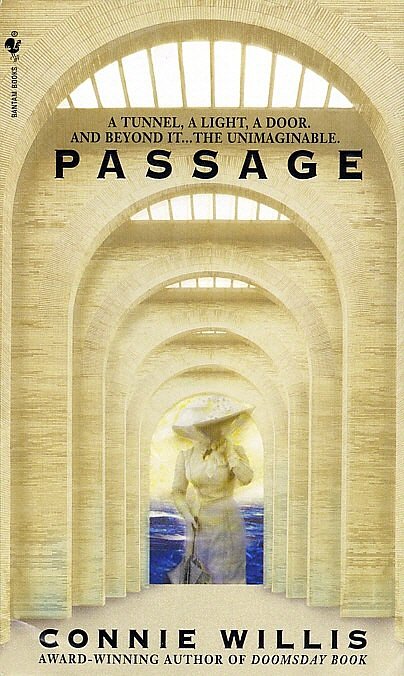
Passage - Connie Willis [2001]

The Blurb
Joanna is a researcher in a hospital who is trying to understand NDEs, or near-death experiences by administering a combination of drugs that mimic the brain's activity when someone undergoes such an experience. Having to contend with misunderstandings about the nature of her work and a religious fanatic, Joanna is naturally shorthanded when it comes to volunteers for her research. As a result, Joanna decides to put herself under and each time, she ends up in the same place, a place that seems eerily familiar.

Through repeated "visits", she is convinced that she is (MINOR SPOILER ALERT) on the Titanic. As Joanna goes under more and more frequently, the duration of her stay on the ship increases, however she always manages to make it back before the ship goes completely down. Her research partner and friends are convinced she's losing her grip on reality, and it seems like the only person who holds the answers is her old high school English teacher...

The Review
First off, I'd like to apologize for the melodramatic way that blurb ended. If you skip blurbs because you don't like spoilers, minor or otherwise, rest assured, it was melodramatic. Anyway. Passage, while a Nebula nominee, doesn't quite have the same flavor as the most other books that find their way onto this list. Instead, it reads like one of the books you would find in the "Fiction/Literature" sections of a bookstore, rather than "Fantasy/Science Fiction". This is not to knock the book in any way. After many books involving (though I hate to stereotype my favorite genres) mages and spaceships, it was a very nice breath of fresh air. I was honestly surprised as how engaging I found the book, given that it's minimally science fiction-y and that it takes place in an all-too-real present. However, I also do crosswords in my spare time, so the bar for holding my interest is probably pretty low...

Though a bit long, Willis does provide some solidly plausible explanations for the "light at the end of the tunnel" and "angelic choirs" that people seem to experience. The requisite thorn-in-the-side character Mr. Mandrake was delightfully frustrating and spiced the book up nicely. A big minus, at least for me, was that the main focus of the book was death. Perhaps it's because I haven't yet come to grips with my own mortality, but having to think about it for extended periods of time was kind of a downer. BUT if you're okay with that, looking for something thought-provoking and casually paced, Passages just might be for you. If you're looking for ALL ACTION ALL THE TIME, or at the very least space travel, a skip skip skip on this one.


TL;DR
Are you okay contemplating your own mortality for extended periods of time? Are you okay with NO spaceships, NO lasers, NO mages? Perhaps you enjoyed Cloud Atlas, Little, Big, or more "literature"-oriented Nebula nominees? Then this is for you! Otherwise, no.


__________
Just in time for the winter holidays! I personally promise an older scifi book soon! I'll try to pick one with pew! pew! lasers, but there's no guarantees...

Thursday, September 22, 2011

Cloud Atlas - David Mitchell [2004]

The Blurb
A bit hard to describe, Cloud Atlas is made up of 6 narratives, connected in a somewhat marginal way to each other. (Think of the movie, Love, Actually.) The book takes on the structure of: A B C D E F E D C B A. I will attempt to provide short summaries below, so yes, spoilers alert! Feel free to skip.

Narrative A is the journal of a man named Ewing who is aboard a ship on his way home. During the voyage, he falls increasingly ill and is tended to by a fellow shipmate who happens to be a doctor. In addition, he must deal with protecting a young stowaway from the Chatham Islands. This takes place around 1850.

Narrative B comes in the form of a bundle of letters written by a man named Frobisher to his friend Sixsmith, dated from the 1930's. Frobisher is a struggling young musician who goes to a small village in hopes of working for a once-great musician. There, he ends up having an affair with his mentor's wife and having to deal with the man's cantankerous daughter. Narrative A is mentioned in passing as part of a journal he finds in the old musician's home.

Narrative C is a thriller/murder-mystery in which a young woman named Luisa Del Rey investigates the doings of a corrupt nuclear power plant. Sixsmith, now greatly aged in the forty years since he corresponded with Frobisher, worked for the power plant and his work is the evidence Luisa needs to blow this case wide open.

Narrative D concerns a man named Tom Cavendish who has a small publishing company about to go under. Narrative C is a manuscript sent to him in hopes of getting published. Through a set of increasingly bizarre events, he gets trapped in a nursing home and plans an attempt to escape along with two other nursing home "inmates".

Narrative E is set in a future where humans are cloned and used as forms of cheap labor. It is believed that clones are incapable of complex thoughts.  Soonmi, a clone working in a fast food chain, starts to experience a desire to learn new things and gets kidnapped (for her own good) by kindly university administrators where is is housed and educated illegally. This narrative is in the form of an interview between Soomni and a young journalist right before she is about to be executed. Narrative D is a movie she ends starts in her time at the university.

Narrative F is set in a post-apocalyptic future where society has broken up into small town/tribes. The vast majority of people surviving the apocalypse are inbred and have a host of genetic problems. The last of a healthy and scientifically advanced people send a researcher to Zachry's town to observe the people and area. Narrative E is seen by Zachry as a video recording through the researcher's device.
Whew!

The Review
Having only two narratives of the book that are strictly "science fiction", Cloud Atlas is definitely one of those books you'd find in the Literature section instead of the Science Fiction section. Since this is a science fiction/fantasy blog, I'll be focusing my review on these two sections.

The two main science fiction ideas running through the two narratives are: Will clones be considered fully human in a future clone-filled society? and Shit! We got too greedy playing God and blew up our own world! While he doesn't bring anything new or surprising to the table, Mitchell does excel at world-building, presenting these two narratives cleanly and without much fuss. The narratives felt like they were just the right length. Long enough for me to not feel short-changed (I mean, I did just read through four other non-scifi narratives...and I'm about to do so again), and short enough so that the "artistic-ness" of the entire book didn't start to piss me off. I mean, nested narratives are a cool concept, but cutting off mid-sentence and starting another narrative? Perhaps this is necessary; I found it to be too much. As a result, the book does come across as pretentious at times.

A few points of warning: As mentioned, this book is consisted of six distinct narratives, only two of which are truly science fiction, so if you aren't into historical fiction, thrillers, or the like, this is not for you. The two sections seem like they'd make sense without having read the rest of the book, but it's worth more of your time to skip this one entirely instead of doing that. In addition, Narrative F is written in what Mitchell imagines our language would sound like in a post-apocalyptic society, and it does get a little tiresome by the end.

In short, Mitchell presents the science fiction portions of his book very well, but if you're thinking of reading it just for the scifi, definitely skip this since his presentation of isn't fresh and exciting enough to warrant slogging through hundreds of other pages. You'll just be disappointed. If, however, you're looking for an interesting book structure and don't mind other genres (which Mitchell has a great way with imitating, writing each narrative in a unique voice), give it a shot.

TL;DR
With only two out of six distinct narratives being strictly science fiction, skip it if you don't want to read through a historical fiction or a thriller, among other things. Check it out if you're okay with other genres or just want to read a book with some interesting structure. Very hit or miss.

__________
After a very very long hiatus, we're back! Hopefully this time, in a regular fashion. Once again, I'm creeping my way up to more posts than Daniel. MUAHAHAHA! I've decided to start reviewing more recent books, since it seems like Daniel's got a fair number of classics covered. Thanks for reading, folks!

Monday, December 27, 2010

All Flesh Is Grass - Clifford D. Simak [1965]


Blurb
In the unremarkable town of Millville, Brad Carter bears witness to the most remarkable event in human history: contact with an alien intelligence. Resembling purple flowers, they have utilized their control over time itself to place a barrier around Millville, preventing access to the outside world. They have come offering humanity their extensive knowledge in exchange for our partnership in their endeavors across time and space. But is anything ever so easy? As Brad tries to learn more about the flowers, nuclear annihilation looms from an increasingly fearful outside world as unrest brews from the terrified citizens within.

Review
All Flesh Is Grass is, at heart, a first contact story with the most unlikely of ambassadors: Brad Carter is a failed insurance and real estate agent in the archetypal small town where nothing ever happens. This backdrop of a dull middle-American town, with all the resident characters you'd expect: the elderly doctor, the beleaguered mayor, the friendly drunk, and others make Brad's plight in dealing with his extraordinary circumstances all the more relatable, and provides additional contrast to the otherworldliness of the aliens. The aliens themselves are rather novel, being hyper-intelligent flowers from a parallel dimension. All these elements come together to form a story that, much like Brad, moves at its own pace, not really in a particular hurry to get from one place to the next. While this may have been done to try to invoke a sense of the mundane world that Brad calls home, it fails to carry the story when it shifts gear into the more fantastical.

Overall, All Flesh Is Grass is a passable novel, and while not excellent, is still certainly worthy of a Nebula nomination. Fans of Simak will recognize his signature style, and it's certainly something different in the first contact sub-genre. Recommended is Asimov's The God's Themselves for another tale of first contact that might not be all it seems.

In Short
All Flesh Is Grass is a unique take on the first contact story that is both familiar and utterly alien at the same time, with sleepy, small-town 1960s America contrasting hyper-intelligent, hive mind flowers.

~~~~~

It seems that even being on break isn't enough to make me overcome laziness. Oh well. Here's a post anyway. I should probably build up a buffer or something so I can immediately retain my lead when Fern posts again. Also, belated season's greetings!

Oh, and I love foreign book covers.

Thursday, November 25, 2010

Chthon - Piers Anthony [1967]


The Blurb
Aton Five's chance encounter with the hauntingly beautiful minionette named Malice as a boy comes to define the rest of his youth and adult life. The exact circumstances which lead to Aton's imprisonment in Chthon, an inescapable labyrinthine prison, are muzzy, but the reason for the imprisonment is certain: his love for the minionette. What's unclear is why it's an unpardonable crime to love her. In order to find out, Aton devises an escape from Chthon. Among the many problems he faces are the deadly creatures in the tunnels of Chthon, his fellow prisoners, and of course, the small fact that no one actually knows where Chthon is located. But is the terrible truth Aton learns about Malice worth the years of agony she has caused him? I guess you'll only find out if you read the book! (Or cheat and Google the plot...)

The Review
Yes yes, we're once again back in the sixties, but I promise some more recent books are well on their way to being reviewed!
Now, Chthon is told in a non-linear fashion, but do not despair of the fact that we know Aton escapes successfully within the first two chapters! No surprise is ruined here! In fact, Anthony pulls this technique off beautifully, pulling the tension away from "Will he escape?" and instead turning it into, "Is all his effort going to be worth it?", which (in my opinion) works much better with the obsession he has with Malice. Furthermore, Chthon blends elements of scifi and fantasy quite well together. While Aton's journey takes him across the galaxies, since a good half of the book is set in Chthon with man-eating beasts and the rest of the book has him battling waking dreams of the minionette, the "science fiction" definitely takes a back burner to the fantasy elements in this book, so hardcore scifi lovers, be warned! To sweeten the disappointment some might feel however, I will say this: Chthon has zombies.
I repeat, Chthon has zombies. And yes, he actually calls them that. But I digress.
Now I don't mean to sound sexist, but Chthon also definitely illustrates the difference between male and female scifi/fantasy writers when it comes to romantic subplots. Maybe it's because I'm female, but I'm always left a little unsatisfied with romantic subplot development by male authors. Everything always seems a little abrupt, and Chthon is no different, though I'm willing to allow that it may be because Aton is so obsessed with Malice that, naturally, any other romance must seem hurried and unsatisfying at best. Still, the juicy secrets of the minionette were so worth it (to me, as a reader) that any drawbacks of the romantic subplot are not enough to unrecommend this book.
Since Chthon was written in the sixties, it seems to follow the trend of being on the shorter side in comparison to the newer Nebula nominees. (This might be because they hadn't yet placed a lower word count limit for "Best Novel", perhaps?) The pacing is quick enough, so expect things to be happening all the time, especially near the end where Anthony seems to get frighteningly fast with events, so don't space when reading!

The Recommendations
-Phthor: This is the sequel to Chthon and follows Aton's son, also in the tunnels of Chthon.
-The Birthgrave by Tanith Lee: This doesn't have scifi in it at all, but if you enjoyed the gradual progress of unraveling the secrets surrounding the minionette, this has a very similar thing going on in terms of finding out the true identity of the main character. It's also features battling demons, both internal and external.
-If you're into space opera, hard scifi, or fantasy involving magic, this is probably not for you.

TL;DR
Aton Five is sent to an inescapable prison colony for loving the minionette Malice, and stages an impossible escape in order to find out why loving her has doomed him. More fantasy than scifi, though it has elements of both.

_______________

Here is the Nebulog's special Thanksgiving review! (If only because the timing happens to coincide.) Happy Turkey Day to all our readers in the US, and to those of our readers who don't celebrate Thanksgiving, Happy Nebulog Update! Also, Daniel, your lead is getting smaller as I update! Muahahahaha. (Now if I can only maintain this updating.....)

Saturday, November 6, 2010

Briar Rose - Jane Yolen [1992]


The Blurb
Rebecca and her two older sisters grew up listening to their grandmother Gemma's unique version of Sleeping Beauty, where she was the princess in the castle. That was twenty-odd years ago, and Rebecca's sisters have "stopped believing fairy tales" and moved on and away. When a dying Gemma charges Rebecca with finding her castle, her sisters urge her not to go chasing an old woman's delusions. However, Rebecca has never stopped believing in Sleeping Beauty, and she sets out on a journey that takes her from North America to Poland and from myth to reality to solve the mystery of Gemma's past.

The Review
Briar Rose is part of the "Fairy Tale Series" where noted fantasists rewrite well-known fairy tales with a new twist. In this case, Yolen has written a book that deftly intertwines the story of Briar Rose and the horror of the Holocaust. The reader is treated to Gemma's version of Sleeping Beauty in chunks, with a little more of it revealed every other chapter, thus juxtaposing the reality of Rebecca's search and the fantasy that is Gemma's story. Yolen hints pretty early on that Gemma's version of the story is merely a metaphor for surviving the Holocaust, after which it's no hard task for the reader to fill in what is representing what in the story. This doesn't serve to ruin the book in any way however, in fact, it allows the reader to focus on and appreciate Ms. Yolen's truly lovely writing. Briar Rose does have a drawback, if only because what was happening was sometimes so thrilling that it overtook my caring about the characters at times.

All in all, a very enjoyable read (and quick, too if you're pressed for time), though perhaps a bit more skewed towards female audiences than the other books that have been reviewed on this blog. Yes, there are no less than two romantic subplots running, but don't let that scare you off, boys! (Though I have on good authority that y'all secretly love romantic subplots, too! Whew, that hits my sexist stereotype quota for the week...) But if you need any excuse, let this review be it!

The Recommendations
Other books in the Fairy Tale Series. Or if you're looking for something shorter (you busy busy person you!), Terri Windling and Ellen Datlow edit a series of books filled with short stories that have the same theme. Snow White, Blood Red is the first in that series, but beware it might be out of print! Other books to recommend are other ones by Jane Yolen (who has written other Nebula nominees so you'll be seeing more of her soon!) and, since Briar Rose is technically a Young Adult novel, books by Dianna Wynne Jones would do nicely, especially Howl's Moving Castle or her adult-oriented books, notably Fire and Hemlock.

TL;DR
Do read! Rebecca grew up hearing grandmother Gemma claim she was Sleeping Beauty in the Wood, and when she dies, Rebecca sets out to solve the mystery of her grandmother's unknown past in Poland.


____________________
Aha! In an effort to keep up with Daniel's prolific posting, I have posted my own review (soon to be reviewS, with an 's'!!) I will not be outdone!  I will, by sheer coincidence, be reviewing books that are probably considered to be more "female oriented" in my next couple posts, (though I bet Daniel's feeling he's dodging multiple bullets on that note...) but that's okay because the females (and fantasists) must be represented, too! Though.. unless I'm quite mistaken, I think Daniel's actually more well-read in fantasy than I am.... Sad! =[

Thursday, September 23, 2010

The Ship that Sailed the Time Stream -G.C. Edmondson [1965]


Blurb
The Alice was an odd ship in the modern navy: wood hulled, sail powered, and sporting a veritable Christmas tree of metal sensors to detect submarines hanging from her mast. But a freak accident involving an illicit vacuum-still hurtles the vessel back in time, making it...The Ship That Sailed the Time Stream!

Review
In a sense, this book itself is something of a time machine, encapsulating the period it was written in and bringing a taste of the early 1960s to readers in the present day. Between the somewhat dated sensibilities regarding minorities and women, the many and repeated references to the now defunct Bureau of Ships (disbanded in 1966, one year after the book was written and four years before the setting of the book), and a couple of historical inaccuracies that have since become relatively common knowledge, this is a book that has not sailed the time stream very well itself. However, this is not to say that it is a terrible book. Once you become acclimated to the odd quirks and plot holes (just why does that vacuum still actually do anything? I dunno, magic) the time travel plot is actually fairly entertaining. The times and locales visited are fleshed out to a pretty good degree, and it's not often that the Islamic Golden Age or prehistoric Mesopotamia are featured in these sorts of stories. There's not a ton of character development, but by the time the Alice's journey comes to a climax, you're at least familiar enough with the crew to become reasonably involved with their plight as a whole, if not the crew members individually.

As a whole, The Ship That Sailed the Time Stream is entertaining, if not a classic for the ages. A decent time travel story, it addresses some large concerns with time travel that many other similar stories gloss over: food and water are suspect, the language barrier is all but inpenetrable (except for the nearly Daniel Jackson-like linguistic abilities of the historian-turned-naval-ensign main character), and the relative movement of the Earth during time jumps is at least mentioned, if not fully expanded on.

One somewhat unusual recommendation is Time Cat, by Lloyd Alexander, which features a similarly hodge podge time travel plot, although aimed at a much younger audience. Additionally, G.C. Edmondson wrote a sequel in To Sail the Century Sea, though I have not yet had a chance to read it.

In Short
The Ship That Sailed the Time Stream is an entertaining romp through the ages, even if it doesn't quite survive its own trip through time without noticeable aging.

~~~~~

Yup, output has definitely fallen after classes started. Oh well, at least I'm still ahead 3-0. I guess I'll take this time to catch up on my Alastair Reynolds while awaiting other reviews... :P

Monday, September 6, 2010

The Fall of Hyperion - Dan Simmons [1990]

Blurb
As the Ouster invasion bears down on Hyperion, the six remaining pilgrims must make their way to the Time Tombs for their final confrontation with the Shrike. Meanwhile, Hegemony CEO Meina Gladstone must decide the fate of human civilization while being advised by the seemingly prophetic dreams of Joseph Severn, a cybrid recreation of the dead poet John Keats.

Review
The second book in Dan Simmons' Hyperion Cantos, The Fall of Hyperion is a direct continuation of the story started in Hyperion, though it breaks from the former's distinctive style of Canterbury Tales-esque frame to tell a more traditional narrative. However, this makes it no less engaging, with the scope shifting from the personal tales of the individual pilgrims to the grander scale of the eve of a massive interplanetary conflict and their role in it. The new character of Joseph Severn serves as a link between the pilgrims' ongoing plight on Hyperion and the center of the war effort directed by Meina Gladstone, whose role is greatly expanded in Fall. Both Severn and Gladstone provide fresh perspectives on the already sprawling plot and are welcome additions to the cast. The original pilgrims themselves are thrust into a much more traditional adventure arc and this may disappoint those looking for more of the Chaucerian style from the first book. The multiple plot threads laid down in those individual tales do come together, though, and the interweaving fate of the pilgrims as they resolve their story-lines makes for a worthwhile tale in and of itself.

All in all, Hyperion was probably the better of the two books, though given their intended design as literally two halves of one very large book, this is probably unfair. Not being terribly well versed in the classics of English literature, I had to look up many of the Keats references liberally scattered throughout the book. Understanding these allusions made the experience much more enjoyable, even if it was a little time-consuming going back and forth. A passing familiarity with Keats' works is at least recommended to get some of the references Simmons works in. The obvious recommendation is Hyperion, which you really should read beforehand anyway.

In Short
The Fall of Hyperion is a satisfying second half to Hyperion, and should not be missed by fans of space operas and John Keats alike. But definitely moreso space operas.

~~~~~

I think not having classes gives me way more free time to write these things (*poke* Fern), but we'll see how long that lasts comes mid September. Also, that's two for two wherein the recommendation is by the same author. I swear, I'll get better at that!

Sunday, August 29, 2010

The Three Stigmata of Palmer Eldritch - Phillip K. Dick[1965]

Not actually the cover of the one I read Blurb
In the near future, life on Martian colonies sucks. The only escape to be found is the use of the drug Can-D, which "translates" its users into the bodies of collectible dolls and accessories in a powerful shared hallucination. When Palmer Eldritch returns from Proxima Centauri with a new drug that is poised to supplant Can-D, the Perky Pat Layout company must uncover the hidden truth behind his claims of everlasting life to those who take it.

Review
Like a good number of Phillip K. Dick's works, The Three Stigmata of Palmer Eldritch toys with ideas of realities layered under, over, and in between the "real" world and each other, in this case with the fictitious future drugs of Can-D and Chew-Z, powerful hallucinogens capable of creating shared realities. These shared hallucinations, which may be more than just that, are woven throughout the plot, to the point where it can be difficult to tell which scenes are taking place in the hallucination world, which are taking place in reality, and which are taking place in a future accessible via the hallucination world. While this may sound convoluted (and it initially kind of is), the layering and interweaving of realities lends a pleasant quality of trippiness that draws the reader into a similar experience as that of the characters on the hallucinogens. It also gives depth to perhaps the most important character in the book: reality itself.

Of the two Phillip K. Dick books that got nominated in the Nebula Awards' inaugural year, The Three Stigmata of Palmer Eldritch is probably my favorite, and is certainly a head above most of the other nominees. If you enjoyed the reality bending nature of Stigmata, then another PKD novel, Ubik, comes highly recommended.

In Short
The Three Stigmata of Palmer Eldritch is probably a close approximation to what reading a Salvador Dali painting while on acid would be like. Ok, maybe not quite, but it's still a damn good read if you're looking for something that'll make you think about the nature of reality.

~~~~~

Greetings also! I'm the writer for this nebulog who is not Fern. You know, in case the abrupt change in style didn't clue you in already. I'll likely end up posting less frequently owing to laziness, so I figured I'd at least get a leg up on writing the first review.

Wednesday, August 25, 2010

Greetings!

Welcome to the flagship post of the Nebulog, wherein we shall be reading, reviewing, and providing a manageable number of spoilers to all of the Nebula Award for Best Novel nominees and winners. (Unfortunately for me, the efficient subheader already stole my thunder.)
Yes, all.
Since The Nebulog hopes to be more efficient than only posting 6 times a year, despite the valiant efforts of the 1975 committee (wherein a whopping 18 books were nominated in all), we will eventually run out of books. However, this is likely a ways away. In fact, knowing us it is very likely a ways away.
Moving on.
The breakdown will be as follows:

-A Picture of the Book's Cover/Covers: While we will try our best to find the most epic (read: ridiculous) covers to you, the reader, this will probably only happen with editions that were printed before or around the 1970's. If we're lucky, as late as the 1980's.
But Fern, you may ask, what if I don't have any epic covers of my own?
Take heart! In just a few years, today's normal covers will have magically transformed into epic covers our children and our children's children will one day come to revere. Frighteningly, it'll happen sooner than you think. Oh, you're laughing now, but one day you'll wake up to find out that 2000 was ten years ago and there are people walking around who don't remember the fact that you couldn't use the internet the same time someone needed to use the phone. Ah, dial-up... I digress.

-A Review of Some Sort: Spoilers will be inevitable, though we will try to keep them to a minimum. We'll include a "This might be your cup of tea if you liked:_______________" near the bottom that will also double as a list of recommendations if you enjoyed the reviewed book. (Or non-recommendations, in the opposite case.)

-A TL;DR: For those readers who don't spend staggering amounts of wasted time on the Internet, this stands for "Too long; Didn't read". If you're in a hurry, not-so-interested in the reviewed title, or can't bear to keep reading because you think we're full of crap, we will include at the very bottom, this small "In Summary" section for today's impatient and time-pressed youth.

No, we will not be reviewing books chronologically since variety is the spice of life! (Really, we might not get to cracking these reviews as quickly as we like and being trapped in the '60s is the quickest way to prevent more reviews from ever seeing the light of day.) So welcome, and happy reading!

Cheers!
Fern

TL;DR: Welcome! We will non-chronologically review a Nebula Best Novel nominee or winner in each post.